
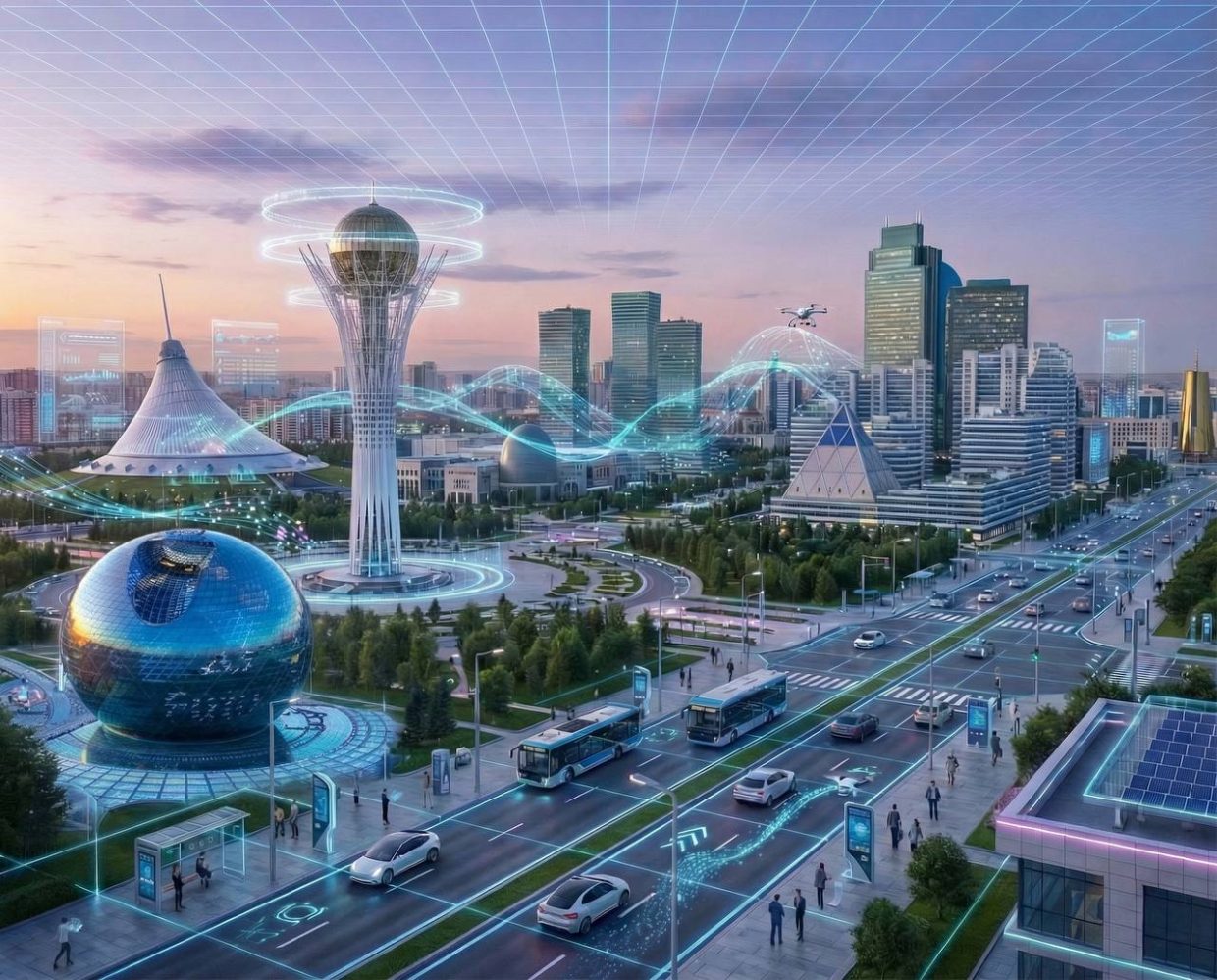
The image was created using AI and is for illustrative purposes only.
Digital twins are becoming the next stage in the evolution of Smart City and Smart Region in Kazakhstan.
Can we understand in advance where traffic congestion will occur, whether networks will withstand new development, and which districts will be most vulnerable to climate or infrastructure risks? Today, these questions are increasingly answered not by intuition or post-factum analysis, but by digital models. Around the world, a new stage of territorial management is developing: urban digital twins.
An urban digital twin is a dynamic virtual 3D model that reflects city life in real time based on data from sensors, video cameras and digital systems. It makes it possible to analyze and forecast urban processes, optimize infrastructure and reduce risks. In essence, it is a tool for centralized data management and AI-based predictive analytics.
For Kazakhstan, this approach is a logical continuation of digitalization. Smart City and Smart Region solutions are already operating in cities, and large data sets have been accumulated. The next step is to integrate them into a single digital model capable of supporting both strategic and operational management. The declaration of 2026 as the Year of Digitalization and Artificial Intelligence strengthens this direction.
Ilya Belyakov, Director of the Technical Department of INTEGRA CITY Group of Companies, and Zarina Dauletkan, Director of the Center for Urban Studies at AlmaU, discuss the opportunities that digital twins can offer Kazakhstan.
How an urban digital twin works and why it is needed
The idea of a digital twin emerged long before Smart City, back in the 1960s, when NASA created virtual copies of spacecraft in order to manage them from Earth. Today, the same principle is being applied to city management.
In the urban context, this is a “living” model that collects real-time data on transport, energy, ecology and infrastructure. By combining these data using AI and cloud technologies, the system makes it possible not only to observe what is happening, but also to model development scenarios and reduce risks before they arise.
Why is this needed? To make decisions proactively rather than reactively. A digital twin helps forecast traffic congestion and network loads, assess the impact of new construction, manage resources, reduce emergency risks and improve the resilience of urban infrastructure.
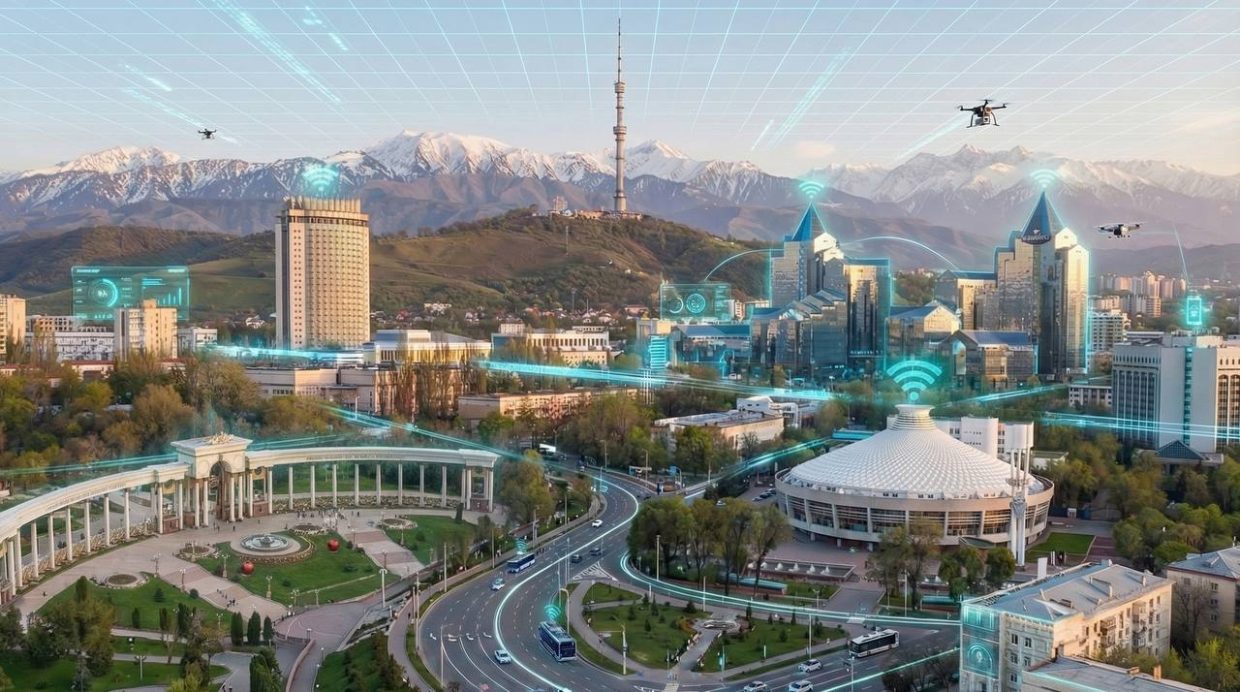
The image was created using AI and is for illustrative purposes only.
Global cases: where digital twins have already become reality
Digital twins have long ceased to be an experiment. Today, they are a working tool for managing megacities. In London, an interactive 3D model helps assess the impact of development on transport and the environment and is used in most city boroughs. Helsinki has embedded its digital twin into its development strategy and applies it in day-to-day infrastructure management.
In Dubai, the Dubai Live platform was launched in 2025: an AI center that coordinates city services in real time. In the Indian city of Varanasi, a 3D model of a 160-square-kilometer area is used for flood forecasting and traffic management.
One of the most ambitious projects remains Virtual Singapore, a national 3D model of the city-state that integrates data on buildings, transport and climate. In Seoul, the S-Map digital platform covers more than 600,000 buildings and underground infrastructure, helping manage city safety and development.
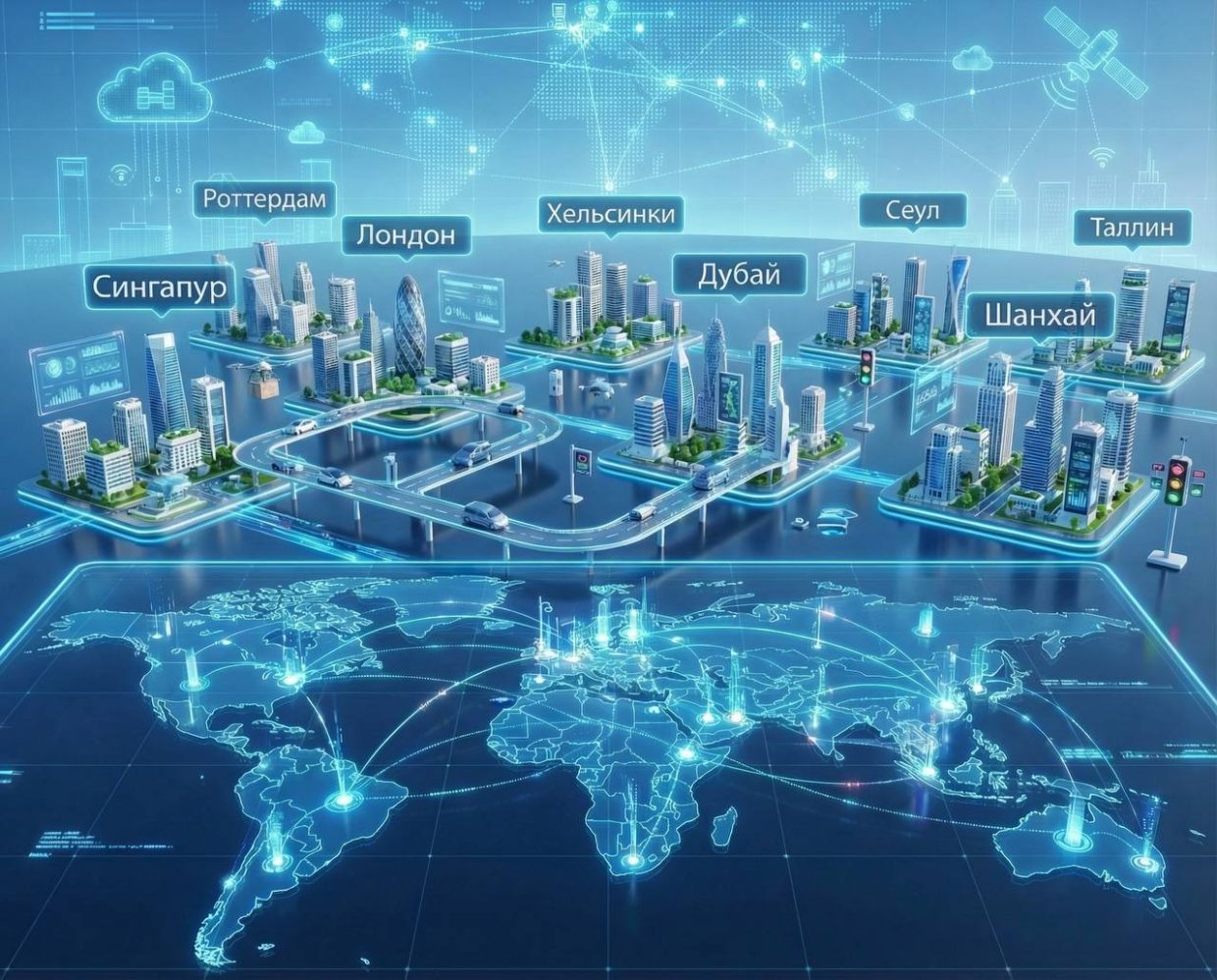
The image was created using AI and is for illustrative purposes only.
From Smart City to digital twin: a new stage in Kazakhstan’s urban development
Kazakhstan has already passed an important stage: cities have learned how to collect data. Cameras capture flows, systems analyze transport, digital maps are being formed, data centers are developing, and Smart City and Smart Region concepts are expanding. State policy is consistently strengthening the focus on AI and digital management platforms. The smart-city.govarch.kz portal was recently presented as a single access point for methodology, best regional practices and tools for digital urban development.
More comprehensive initiatives are also being formed. Back in 2024, Kazakhstan announced the creation of a virtual copy of its road infrastructure. The Kazakhstan Road Research Institute, KazdorNII, began developing digital twins of highways, while Almaty officially plans to launch a full digital twin by the end of 2026, preceded by a pilot project in one district.
In essence, this is a transition from accumulating data to uniting it. Much of the infrastructure has already been digitized; now the task is to assemble it into a single model capable not only of recording what is happening, but also of forecasting urban development.
What digital solution developers and urbanists say
As experts from the international technology holding INTEGRA CITY note, Smart City is now evolving from a set of fragmented digital services into a manageable, predictive and unified city management system. The digital twin is the layer that makes this transition possible.
“A digital twin combines data from transport systems, engineering infrastructure, safety, ecology and administrative services into a single city model. This is a transition from a set of solutions and isolated verticals to a manageable urban operating system. Without a digital twin, Smart City is reactive because it relies on historical and current data. With a digital twin, it becomes predictive thanks to AI analytics and the combination of data expressed in scenario modeling across different future horizons. This is effectively a transition to a decision intelligence model, where the city is managed based on simulations and scenarios, not only on actual incidents,” says Ilya Belyakov, Director of the Technical Department of INTEGRA CITY Group of Companies.

Photo: Ilya Belyakov, Director of the Technical Department of the INTEGRA CITY group of companies.
He added that the company is developing an ecosystem of AI solutions for centralized management, from infrastructure construction to service support. The platform covers urban infrastructure management, public safety, digital public administration and protection of strategic facilities. Implemented initiatives include projects in African countries, as well as potential areas of cooperation in Southeast and Central Asia. INTEGRA CITY supports the state course toward digital transformation and views Kazakhstan as a promising market for introducing such solutions.
In his assessment, Kazakhstan is currently in an active phase of preparation and early implementation of urban digital twins, but has not yet reached the final stage of full readiness. Several large cities are already forming digital twin initiatives. For example, Astana is developing a large-scale Smart City project with digital twin elements, using IoT infrastructure and artificial intelligence as part of a multi-year urban digitalization program. It is expected to provide real-time infrastructure monitoring and management, data integration and forecasting to improve city management efficiency.
The prerequisites generally mirror the global trend: city administrations want to move away from a “digital zoo” toward a unified management and decision-making system. Challenges remain in the full digital integration of different systems, standardization and evaluation of the impact of Smart City solutions, as well as the need to develop IT infrastructure and competencies in order to move from pilots to broad implementation of digital twins in all key cities of the country.
“International technology companies can bring proven architectural practices, security standards and experience in scaling digital city models to Kazakhstan, accelerating the transition of digital twin projects from pilot phase to industrial operation. The expertise of such companies, including INTEGRA CITY, helps build integrated platforms ready to work with global data ecosystems and AI tools. They can also support knowledge transfer and the development of local competencies through training, certification and joint innovation projects. As a result, international partnership strengthens the resilience, predictability and economic efficiency of city management based on digital twins,” the expert emphasized.
According to Zarina Dauletkan, Director of the Center for Urban Studies at Almaty Management University (AlmaU), from an academic perspective digital twins change the very logic of planning. “Previously, cities were designed largely on the basis of regulations, statistics from previous years and expert assessments. Today, we can model scenarios in advance: how traffic will change if a street is closed, how greenery will affect temperature, and how new development will influence access to schools or public spaces.”

Photo: Zarina Dauletkan, Director of the Center for Urban Studies, AlmaU.
At the same time, she emphasizes that “technology itself does not make a city better. It only improves the quality of decisions. If a city has no strategy, values or professional expertise, a digital twin will become a beautiful picture. If there is a systematic vision, however, it is a powerful tool for making more grounded, transparent and long-term decisions.”
Digitalization also affects the training of specialists. “Today, an urbanist must not only understand spatial development, but also be able to work with data, analytics and digital modeling tools,” the expert notes. Using the Urban Studies and City Management educational program at AlmaU’s Institute of Urban Studies as an example, data skills are an important specialized component throughout the entire learning process.
“The future of urban planning lies in the combination of technology, research and dialogue with society. A digital twin is one of the tools that helps us speak about the city in the language of data, not only intuition,” she stressed.
Digital twins are no longer merely a technological concept, but a tool for a new model of city management. For Kazakhstan, they offer an opportunity to move from fragmented digitalization to systematic data-driven governance, improve infrastructure resilience and quality of life. The question is no longer whether digital twins are needed, but how quickly and consistently they will become part of urban reality.