
Kyrgyzstan is entering a phase of active urbanization. According to UN forecasts, the share of residents living in the country’s large cities will grow to 43.4% by 2050. Bishkek’s new master plan assumes that the capital’s population will approach 2 million people by that time. These figures mean not simply urban growth, but a deep transformation of the economy and way of life.
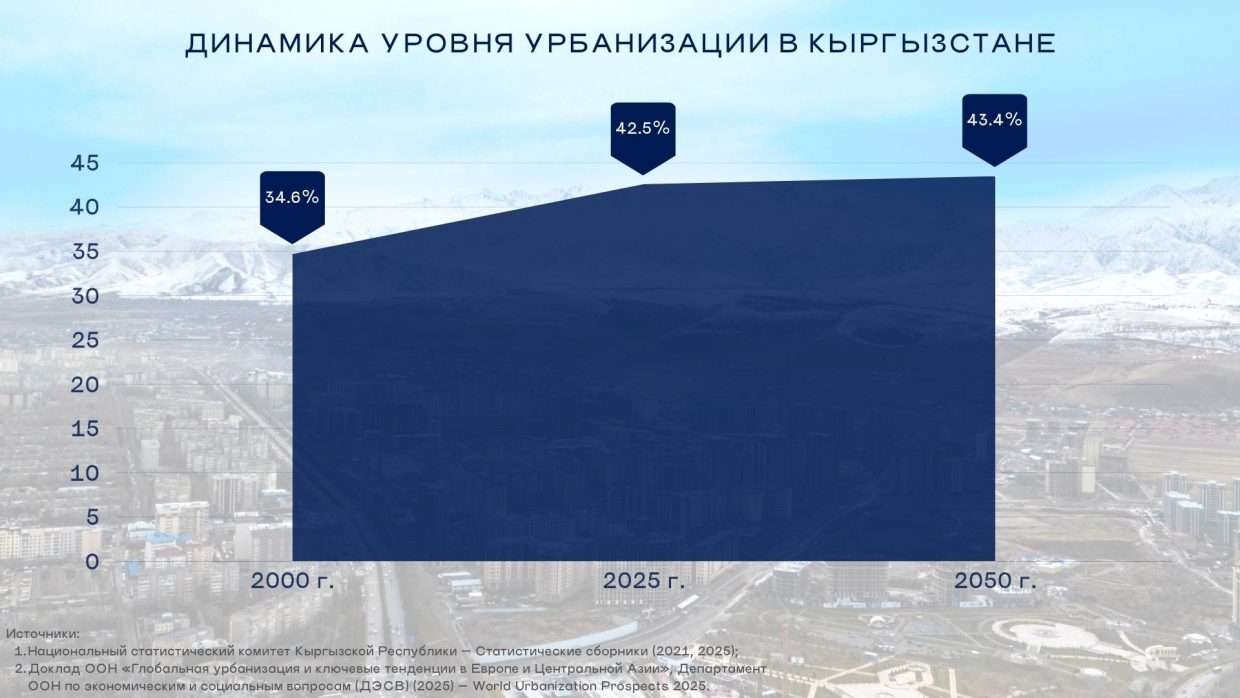
Illustration: dynamics of the level of urbanization in Kyrgyzstan.
Urbanization usually serves as an important driver of socio-economic progress. The concentration of people and businesses in cities contributes to GDP growth, higher labor productivity, the development of small and medium-sized enterprises and the creation of new jobs. Cities provide broader access to education, healthcare, cultural life and innovation, becoming centers of IT startups, science, services and manufacturing. In the long term, this reduces population outflow from the country and helps build a sustainable economy.
However, as cities grow, chronic problems also become sharper: overloaded roads, rising street crime, inefficient management processes and bureaucracy. If these issues are not addressed systematically, they begin to slow economic growth and directly worsen quality of life for citizens. That is why digital and intelligent technologies are now coming to the forefront as tools for data-driven city management.
Urban problems as a point of growth
The rapid population growth of Bishkek, Osh and regional centers is sharply increasing the burden on transport infrastructure, utility services and government bodies. Management models formed decades ago do not scale to modern cities and new volumes of data. In these conditions, technology ceases to be a fashionable trend and becomes a condition for the “survival” of large cities.

Photo: Bishkek city.
Traffic congestion: how technologies relieve the streets
One of the most urgent and painful urban problems is road congestion. Ten-point traffic jams have already become an integral part of life in the capital. Their cause is not only the number of vehicles, but also chaotic movement and the lack of flexible traffic management. Modern technologies make it possible to move from static schemes to adaptive traffic control systems.
At several intersections in the capital, the Automated Traffic Management System is already operating, enabling real-time monitoring and regulation of traffic flows. The authorities of Kyrgyzstan also plan to introduce smart traffic lights with priority for buses and dedicated public transport lanes in Bishkek, Osh and a number of other cities — Manas, Talas, Tokmok, Batken, Naryn and Karakol. Such solutions increase the speed of public transport, make it more predictable and attractive for citizens, and in the long term reduce the number of private cars on the roads.
Traffic violation cameras installed under the Safe City project also play an important role. They not only improve driver discipline, but also reduce accident rates by making punishment inevitable. Representatives of the monitoring center of the Road Safety Department of the Ministry of Internal Affairs reported that the number of road accidents in Bishkek areas where hardware and software complexes were installed decreased by 3.5%, and in Chuy Region by 14%.
Crime and safety: the city under digital protection
Growing population density inevitably requires new approaches to ensuring safety. The traditional model based on reacting after the fact is becoming insufficient. It is being replaced by data-based prevention.
The Safe City and Safe Country projects are already demonstrating tangible results: since 2021, the number of crimes in Kyrgyzstan has decreased by 69%. Video surveillance cameras and video analytics systems help not only record offenses, but also solve crimes — including high-profile ones — in hot pursuit.
Integrating video cameras with emergency services shortens response times, while the presence of video surveillance reduces street crime in controlled areas. As a result, a safer urban environment is formed, where technology works not as an instrument of total control, but as a mechanism of protection and prevention.
Bureaucracy: from queues to a service-oriented state
Another challenge for growing cities is bureaucracy. By decree of the President of the Kyrgyz Republic, a debureaucratization program has been implemented since last year. It is aimed at reducing procedures, eliminating excessive certificates and requirements, accelerating the provision of public services, transitioning to digital document management through the Tunduk system and improving the efficiency of the civil service.
Digitalization is becoming the key to reducing the burden on both government bodies and citizens. In 2025, public service centers received 3.6 million requests, of which 527,000 services were provided digitally. Today, more than 190 public services are available on the Tunduk platform, and the application itself has around 3 million users. Digitalization is gradually covering all areas of government. This means fewer visits to agencies, less human factor and greater transparency.
The transition to a service-oriented state changes the very philosophy of interaction: the state becomes a convenient provider of services rather than a source of barriers for business and citizens.

Bishkek city. Author of the photo: Nikolay Gladkov.
The city of the future: where digitalization is heading
Despite progress, the path toward a smart city in Kyrgyzstan remains challenging. Key obstacles include fragmented solutions, a shortage of personnel and the need for infrastructure development. The next important stage is the integration of transport, safety systems and public services into a single digital platform where data works together. To achieve this, the state is joining efforts with technology partners that help accelerate the construction of the country’s digital economy and share international practices.
According to Ilya Belyakov, Director of the Technical Department of INTEGRA CITY Group of Companies, for citizens a “smart city” is not simply sensors and video cameras, but reduced congestion, faster services and improved safety. Cities most often face not a lack of technology, but a lack of integration between technologies and, as a result, inefficiency. Modern technologies make it possible to unite data in a single management platform, anticipate problems before they occur and respond to them more intelligently.
Big data and artificial intelligence are showing particular promise in solving old problems. They make it possible to move from “patching holes” to forecasting issues. According to Minister of Digital Development Azamat Zhamangulov, the capacities and infrastructure necessary for introducing AI into the work of government bodies and businesses will become available in Kyrgyzstan as early as 2026.
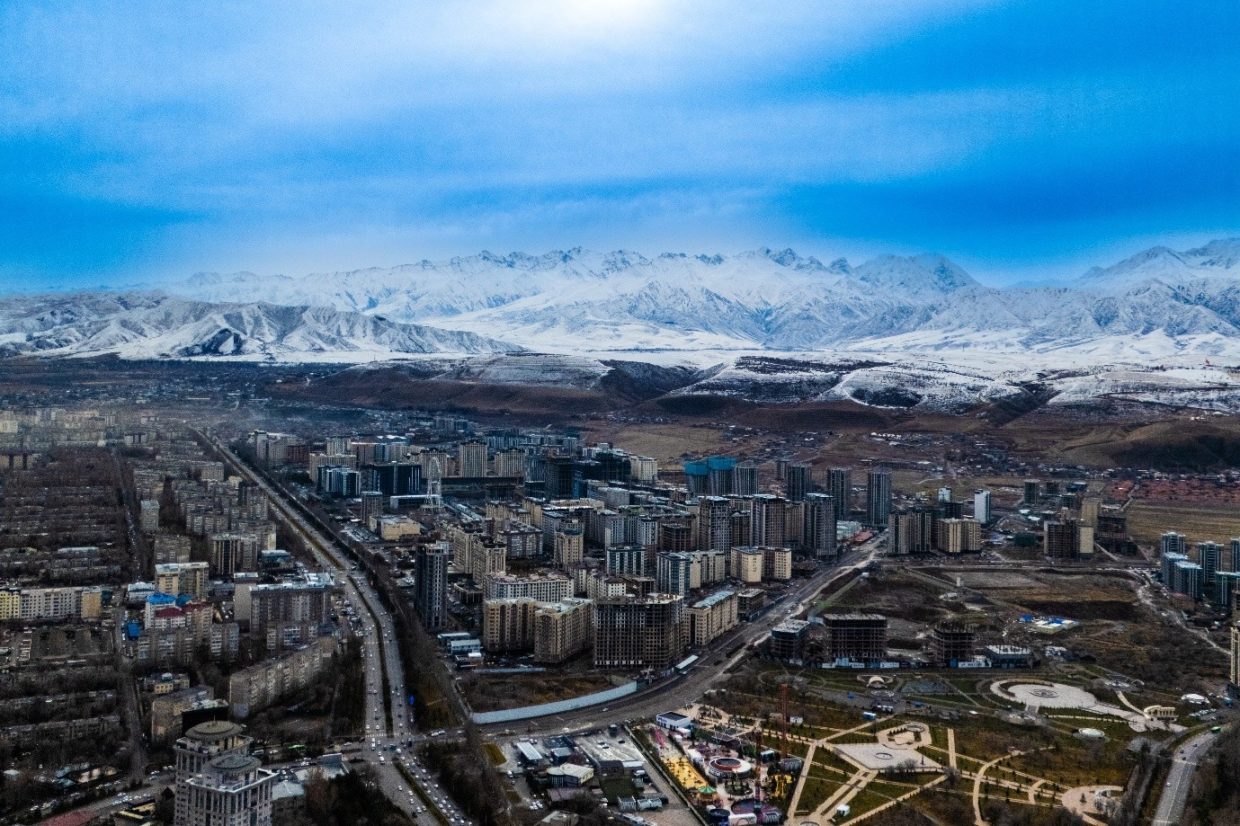
Bishkek city. Author of the photo: Nikolay Gladkov.
Urbanization in Kyrgyzstan is not a threat, but an opportunity — provided that urban growth is accompanied by smart management, digital solutions and a focus on data. Technologies do not replace city management, but they make it more efficient, transparent and scalable.
In this context, traffic congestion, crime and bureaucracy cease to be unsolvable problems and become manageable processes. This means that Kyrgyzstan’s cities have a chance to become not only larger, but also more convenient, safer and economically sustainable.