

Photo: City of Bishkek.
The future is truly not far away — it is already on the streets of our cities. Smart traffic lights adapt to vehicle flows and regulate traffic, facial recognition cameras help monitor public safety, and intelligent metering systems save electricity and water.
The global Smart City trend has long ceased to be science fiction, and now it is gradually taking shape in our country as well. Behind the big words about digitalization is real work — from infrastructure modernization to the implementation of intelligent systems and pilot technology projects. All of this is shaping a new urban landscape where technologies become part of everyday life.
In this article, we examine how Kyrgyzstan is catching up with world leaders in creating digital cities, what solutions are already being implemented and what prospects are opening up for cities and residents in a future being built today.
A global course toward intelligence
Just ten years ago, the idea of a smart city seemed like a futuristic prediction from films about the future. Today, it is a new reality in which the world’s largest economies are actively investing. According to Global Market Insights, the global smart city solutions market was valued at USD 634 billion in 2024 and could grow to USD 2.74 trillion by 2034, with an average annual growth rate of 15.8%.
Global market size of Smart City solutions
This rapid growth is easy to explain: cities are expanding, technologies are developing, and people increasingly expect comfort, safety and environmental responsibility from the urban environment. Urbanization, digitalization of infrastructure and the introduction of the Internet of Things (IoT) are becoming key drivers of a new urban era.
In many countries, governments are prioritizing smart and sustainable development programs. Although Kyrgyzstan’s cities are not comparable in technological sophistication to megacities such as Singapore or Dubai, the country is confidently moving in the same direction. Here, digitalization of the urban environment is ceasing to be a buzzword and gradually becoming concrete action: the introduction of intelligent traffic management systems, video cameras, metering and monitoring systems, and solutions that improve citizens’ quality of life.
What is behind the Smart City concept and why does Kyrgyzstan need it?
A Smart City is not simply a city filled with technology. It is a living ecosystem where data, innovation and people interact with one another. Modern technologies make it possible to improve city services, save resources, reduce costs and organize infrastructure so that everything — from transport to lighting — operates efficiently and benefits residents.
Key areas of a smart city include:
- Transport and mobility — smart traffic lights, traffic monitoring and digital parking reduce congestion and make movement faster and more convenient.
- Energy and environment — energy efficiency and emissions control systems help conserve resources and protect the environment.
- Safety — intelligent video cameras and data analytics increase the level of protection for citizens.
- Digital services for citizens — e-services, online payments and city applications make interaction with authorities simpler and more transparent.
- Infrastructure management — digital monitoring helps identify and solve urban problems in a timely manner.
Ilya Belyakov, Director of the Technical Department of INTEGRA CITY Group of Companies, notes: “For Kyrgyzstan, Smart City is a response to the challenges of the time. The country is urbanizing, cities are growing, and infrastructure requires new solutions. Smart technologies make it possible not only to improve quality of life, but also to manage limited resources more effectively. It is important to think strategically and comprehensively about building a city digital ecosystem, while also applying an approach that takes into account international practices and local specifics.”
Who is setting the pace in Smart City today?
When looking for a benchmark smart city, Singapore almost always appears at the top of the list. Here, technology has become part of the city’s DNA. The Smart Nation initiative brings transport, healthcare, safety and energy into a single digital ecosystem and makes governance comprehensive.
Another prominent example is Barcelona, one of the pioneers in the use of IoT technologies. Thousands of sensors across the city monitor lighting, parking and air quality. The result is millions of euros in utility savings and a noticeable improvement in environmental standards.
Seoul is actively developing digital government: citizens can receive most services online, while city administration uses real-time data for decision-making.

Illustration: Global market size for Smart City solutions.
Among the key trends of 2025, several stand out in particular: the development of AI-driven transport, the creation of city digital twins, the introduction of smart waste processing systems and the scaling of green technologies.
The experience of global Smart City leaders shows that a smart city is evolving from a collection of sensors and screens into an integrated data-driven management system — transparent, flexible and human-centered.
Kyrgyzstan enters the era of digital cities
Not long ago, the idea of a smart city seemed like something from a futuristic film for Kyrgyzstan. Today, it is already a reality.
On the streets of Bishkek, Osh and other cities, video analytics and surveillance systems with facial recognition are already operating, along with traffic violation detection systems. Smart traffic lights and automated traffic management systems help regulate vehicle flows and reduce congestion. In the capital alone, 21 intersections are already connected to the system, with another 27 planned. Across the country, more than 4,000 video cameras monitor safety in real time, including cameras using facial recognition technology. On the instructions of Sadyr Japarov, their number is planned to be increased to 20,000 under the Safe Country project.
At the same time, digital urban infrastructure is developing: smart parking integrated with the Autoevacuator system is emerging, pilot projects of interactive bus stops are being launched, and smart water and electricity meters automatically transmit readings and save resources.
Urban digital services are also improving — from electronic public services to online utility payments and mobile applications that allow residents to report infrastructure problems. Government structures, including education, healthcare and law enforcement, are gradually moving into the digital space, becoming more efficient and accessible for citizens.
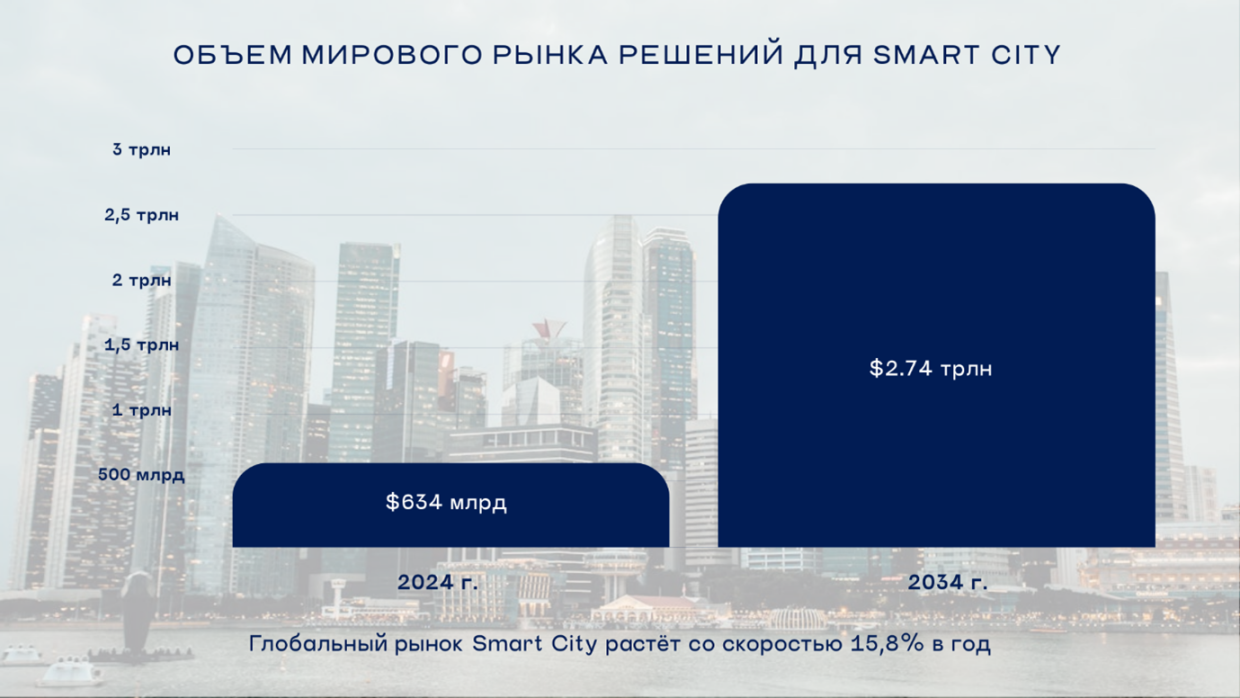
Illustration: examples of Smart City solutions implementation in cities around the world.
Kyrgyzstan’s second-largest city, Osh, is keeping pace with the capital in the digitalization of urban infrastructure. On Osh roads, the Safe City component of the Smart City project is operating, including devices that detect traffic violations. Under the Safe Country project, facial recognition cameras help prevent crises and fight crime. The digitalization of electricity metering has also been fully completed: in autumn, the installation of smart meters in the southern capital reached 100%. In February this year, President Sadyr Japarov laid a capsule at the foundation of the Osh City IT town, which is intended to become the country’s technology hub with developed smart city infrastructure.
The large-scale project of Asman, a fully ecological and smart city on the shore of Issyk-Kul, is giving new momentum to the Smart City movement. Plans include the introduction of advanced technologies: electric vehicles and electric public transport instead of gasoline-powered cars, smart homes with energy-saving and automated management systems, digital infrastructure monitoring, automation of utility management and environmental control. Asman City embodies a new era in the development of Kyrgyzstan’s cities.
The concept of smart cities opens the way for large-scale economic change in Kyrgyzstan. With the active development of the IT sector, government support and international experience, the country has every chance to become a regional leader in digital transformation. A smart future is being laid in the present — and it is not a luxury for megacities, but a necessary tool for sustainable development that helps countries and cities of any scale use resources rationally, improve safety and enhance people’s quality of life.