
The development of artificial intelligence and computer vision is making facial recognition technologies an integral part of the modern urban environment.
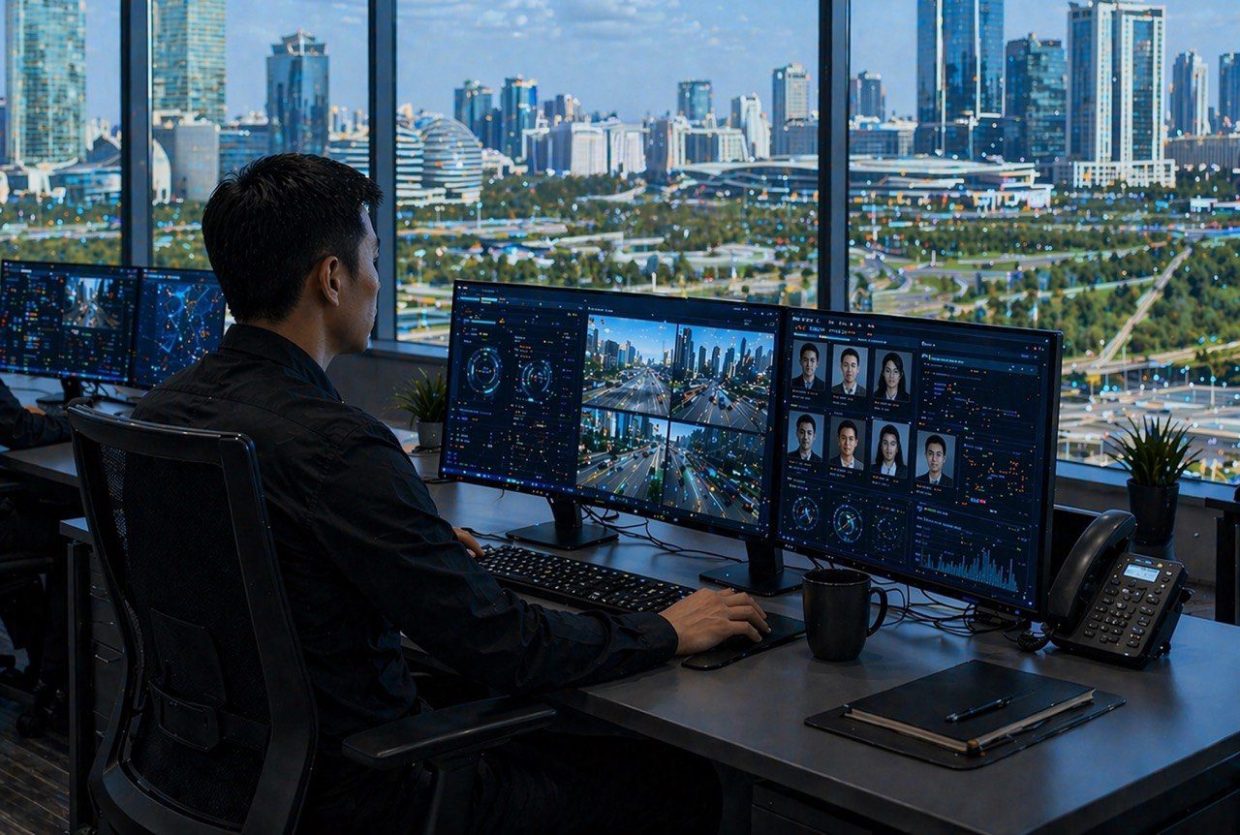
The image was created using AI and is for illustrative purposes only.
We are used to video surveillance on city streets: it has become part of the background of urban life. But today, it is no longer simply an “eye” recording what is happening. Modern video monitoring systems can analyze, compare and draw conclusions in real time. This is why facial recognition technologies raise so many questions: how do they work, and what exactly does the system “see”?
How It Actually Works
In simplified terms, the principle is quite clear. Video devices capture an image, after which the algorithm detects a face in the frame. The system then identifies key points: the distance between the eyes, the shape of the nose, the line of the cheekbones and the contour of the lips. Based on these parameters, a mathematical model is created — a unique digital “fingerprint” of the face.
Importantly, the system does not work with a photograph, but with a set of numbers. This digital vector is compared with databases or used for event analysis. The entire process takes fractions of a second and can take place simultaneously across thousands of video streams.

The image was created using AI and is for illustrative purposes only.
Video Surveillance No Longer Simply “Watches”
Facial recognition, however, is only part of what these systems can do. Modern video analytics can “understand” what is happening in the frame: detect crowds, track vehicle movement and identify abnormal situations. Video surveillance systems are no longer passive tools; they are becoming part of the city management system.
This is where their practical value emerges. In the field of public safety, such technologies make it possible to find wanted persons more quickly and detect incidents promptly. On roads, they can record violations without the involvement of an inspector, reducing the human factor. In urban management, they help analyze flows and support data-driven decision-making.
How It Already Works Around the World
Globally, this has already become a standard practice. In Singapore, computer vision systems are integrated into public safety and transport infrastructure. In London, the police use Live Facial Recognition to search for people directly within street flows. In Dubai, video analytics is integrated into a unified Smart City platform that coordinates the work of urban services. In Shanghai, facial recognition technologies are used in the metro, at railway stations and in access control systems.
Kazakhstan is moving in the same direction. Major cities have already built the basic infrastructure: operational control centers, violation detection systems and thousands of video devices connected into a single network.

The image was created using AI and is for illustrative purposes only.
Why This Is Being Discussed Now
The topic has become especially relevant in recent weeks. The reason was the amendments to Article 31 of the Code of Administrative Offenses, which came into force on March 12 as part of the so-called “Digital Code.” The new provisions expand the possibilities for automatically detecting existing violations: if the use of a phone while driving or a seat belt violation was previously recorded by police officers on the road, intelligent systems can now perform this function.
According to Ilya Belyakov, Director of the Technical Department of the INTEGRA CITY group of companies, modern technologies have already gone beyond conventional video surveillance:
“Today, facial recognition systems are part of a unified digital city platform. Artificial intelligence analyzes video streams, identifies patterns and helps build response scenarios. Even when a person’s appearance changes, the system relies on stable biometric features, while approaches such as data augmentation and the combination of different parameters — from the face to gait — make it possible to maintain high accuracy in real-world conditions.”

Photo: Ilya Belyakov, Director of the Technical Department of the INTEGRA CITY group of companies.
Such solutions are already widely used in public spaces — from streets and transport hubs to airports, railway stations and shopping centers — where it is important to ensure a high level of security and a rapid response to incidents.
INTEGRA CITY, an international technology holding company and a potential technology partner for governments in the digitalization of urban infrastructure and public administration, develops and implements such technologies. Within its platforms, including Nexus (“Safe City”), the company uses artificial intelligence and computer vision to analyze video streams, automate security processes and support real-time decision-making.
As Saltanat Azirbek, an official representative of the Almaty Police Department, notes, in 2025 alone more than 4,500 crimes were solved using video systems, including facial recognition technologies. The functionality is expected to be expanded further.
“Today in Almaty, video surveillance no longer simply records what is happening — it helps understand and respond. The city has around 180,000 cameras, almost 67,000 of which are connected to the Operational Control Center. At the same time, around 5,000 cameras are equipped with facial recognition functionality, and this tool is already being actively used in police work. With its help, missing persons and wanted individuals can be identified in real time. Overall, video analytics is becoming an important part of everyday police operations: it helps respond to situations faster and work with data more accurately. It is important that every resident and visitor of Almaty feels calm and safe in the city.”
Balancing Technology and Citizens’ Rights
In many countries, the introduction of facial recognition technologies is accompanied by the development of clear rules for their use. The focus is on personal data protection, transparency and control over access to information.
Modern systems are applied within the framework of legislation and are limited to specific tasks, primarily in the field of security. This makes it possible not only to increase the efficiency of city services, but also to maintain a balance between technological development and citizens’ rights.
The Digital Future of Cities
The development of artificial intelligence and computer vision continues to expand the capabilities of urban systems. In the coming years, such technologies will be able to analyze events more accurately, forecast risks and integrate with digital city management platforms.
In Kazakhstan, these processes are becoming part of a broader transformation: the transition to a digital state and the development of the Smart City and Smart Region concepts. Intelligent video surveillance systems form the foundation for creating a unified digital management framework for the city, where data is used to improve safety, efficiency and quality of life.
Thus, facial recognition technology is not merely a tool of control, but an important element of digital infrastructure that helps cities become more manageable, safer and more human-centered.