
In 2025, Kyrgyzstan’s urbanization rate rose significantly, reaching almost 42%, which is 7% higher than two years earlier. Bishkek has also become one of Central Asia’s pilot cities for introducing elements of smart urban infrastructure.
On the path toward economic growth, cities are becoming key support points and regional centers of development. Today, Kyrgyzstan faces the task of fundamentally transforming its urban environment, where digitalization is an important — but not the only — component.
Pavel Loran, Head of the Representative Office of INTEGRA CITY Group of Companies in Central Asia — an international company implementing digital ecosystems and smart city technologies — explains what solutions are needed for comprehensive urban transformation in the country. In his view, genuine urban transformation requires an integrated approach combining three interrelated areas: deep digitalization of governance, physical modernization of infrastructure, and the creation of integrated solutions that connect technologies with physical assets.

Photo: Pavel Loran, Head of the INTEGRA CITY Group of Companies’ Representative Office in Central Asia.
What is needed today for a full and systemic transformation of cities?
“In our vision, cities — as the main points where population, infrastructure and resources are concentrated — have the greatest potential to launch systemic change. The foundation of transformation should be the creation of modern analytical centers capable of processing urban data in real time. These centers will become the ‘brain’ of city management, coordinating all services, from transport to utilities.”
However, their effectiveness directly depends on the quality of physical infrastructure. That is why large-scale infrastructure projects must be implemented in parallel: building modern transport interchanges, introducing paid parking systems with dynamic pricing, creating park-and-ride hubs and renewing road surfaces.
What challenges arise along this path?
“Today, the need to coordinate between different agencies and services is particularly challenging. Experience shows that the most effective solution is the creation of a unified coordination center that brings together municipal services, transport operators, utility providers and digital platforms. This approach helps avoid fragmented transformation and ensures comprehensive development of urban space.”
What can become the driver of global urban infrastructure transformation?
“A key condition for success is attracting a strategic partner-investor capable of ensuring the full implementation cycle — from design to long-term operation over 10–15 years. Only such a fundamental approach can guarantee the sustainability of transformation, gradual development of local competencies and continuous renewal of technological solutions.”
What does digital support for urban development include?
“Specific projects must be developed with mandatory consideration of their digital support. For example, paid parking requires convenient mobile payment applications with an integrated navigation system. New transport interchanges need intelligent traffic management systems. Modernizing public transport requires unified logistics and ticketing platforms. This integrated approach has already proven its effectiveness in various countries around the world.”
Is the creation of “smart cities” possible in the country’s current realities?
“Creating smart cities in Kyrgyzstan requires comprehensive digital transformation of urban infrastructure. The foundation should be modern telecommunications networks, including fiber optics and data centers integrated with smart energy grids. A key element will be the development of a city digital twin that can model transport flows, forecast infrastructure loads and optimize urban planning decisions.”
The transport system urgently needs intelligent solutions: adaptive traffic lights, digital information systems and mobile services for drivers. Particular attention should be paid to the construction of modern road interchanges and the use of innovative asphalt technologies, which can significantly improve road quality and reduce congestion.
Safety can be ensured through integrated video surveillance systems with real-time analytics and automated alerts to emergency services, complemented by energy-efficient smart lighting. At the same time, the digitalization of public services and utilities should be accelerated through unified platforms that are convenient for citizens.
Implementation of these measures will require a phased approach with mandatory adaptation of technologies to local conditions. In the long term, this will create the foundation for sustainable urban development and improved quality of life.
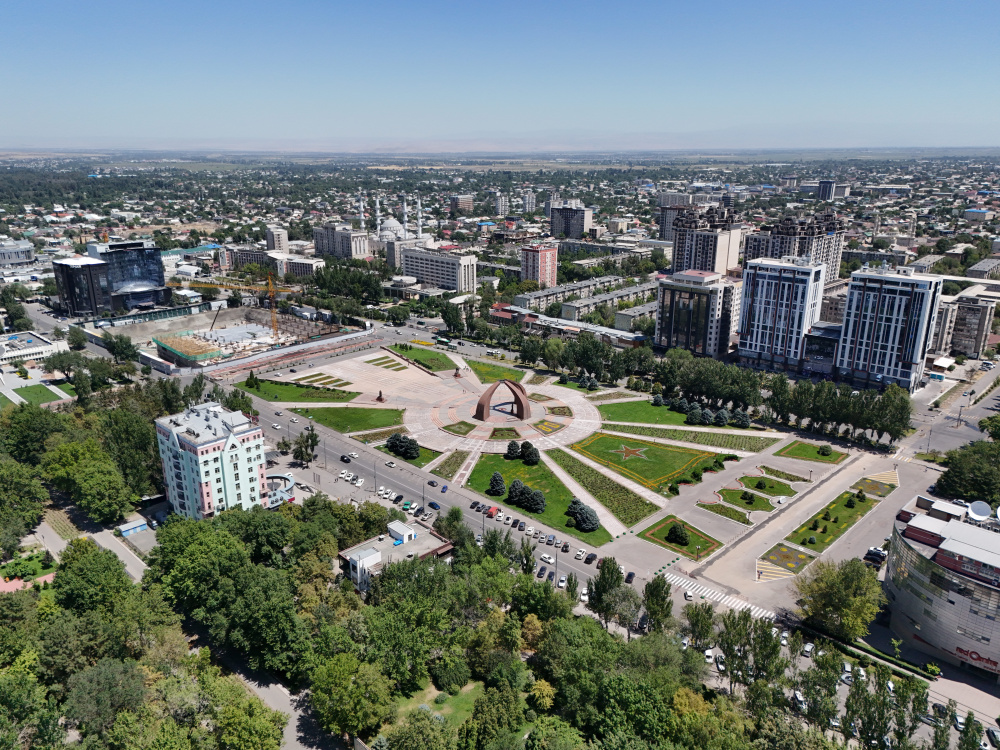
Photo: Bishkek, Chuy Avenue
Are the forecasts for urban transformation in Kyrgyzstan promising?
“Kyrgyzstan has all the necessary prerequisites for successful transformation: political will, a young technology-oriented population and an understanding of the importance of a systemic approach. Implementing such large-scale programs designed for the long term will make it possible to create a modern urban environment that is comfortable for life, where digital technologies serve not as an end in themselves, but as a tool to improve every citizen’s quality of life. Such a result is worth all the effort required to achieve it.”
Comprehensive urban transformation is not a set of disconnected initiatives, but a carefully designed strategy where digital solutions and infrastructure projects work as a single ecosystem. Kyrgyzstan has already taken its first steps, but the main changes are still ahead: creating effective urban “brain centers,” modernizing transport and engineering networks, and integrating services into convenient digital platforms. This approach will not only improve citizens’ quality of life, but also turn cities into points of economic growth, investment attraction and innovation. The key is to maintain a long-term goal and consistency of action, because these are what turn technological projects into a sustainable future for the whole country.