
Today, one of the key development vectors in Kyrgyzstan is the country’s urbanization. At the beginning of 2025, Kyrgyzstan had a population of 7.3 million people, and almost every fifth resident lived in Bishkek. According to official data, the capital’s population reached 1,321,877 people, with further growth expected in the next couple of years.
The city is changing, and the key question now is: what should Bishkek become in order to be comfortable and safe for everyone? The answer to this challenge is the development of inclusive safety as a new standard of the urban environment. Inclusivity means urban infrastructure designed and adapted to the real-life needs of all citizens, rather than an “average” resident.
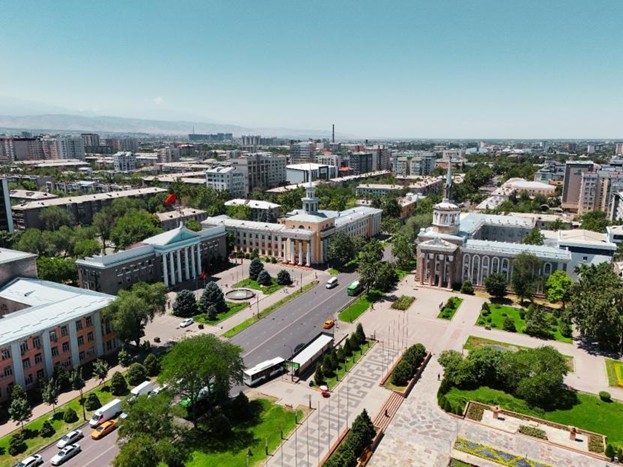
Photo: Bishkek, Ala-Too Square.
What everyday scenarios do residents face in a large city?
In everyday urban scenes, it is not difficult to imagine a mother with a stroller rushing on errands and having to walk around cars parked in the wrong place. Or an elderly person who is afraid to leave home in the evening because there is no street lighting and it is difficult to call for help in an emergency. It could also be a schoolchild walking home after classes along a road with no speed bumps and no street cameras. A person with a disability may face a range of difficulties in solving daily tasks because the city often simply does not take their needs into account.
A “smart city” as the technological foundation for inclusive safety
Inclusive safety is impossible without a reliable technological foundation. As the urban population grows, the idea of transforming the capital into a “smart city” is gaining momentum — a city where safety is not only a task for the police, but part of a technologically considered and human-centered environment.
A “smart city” is not only about the presence of video surveillance cameras. It is a systemic transformation: platform-based solutions that include all components of urban infrastructure, from safety systems to efficient transport and utility services, and allow cities to respond to issues before they escalate into crises.
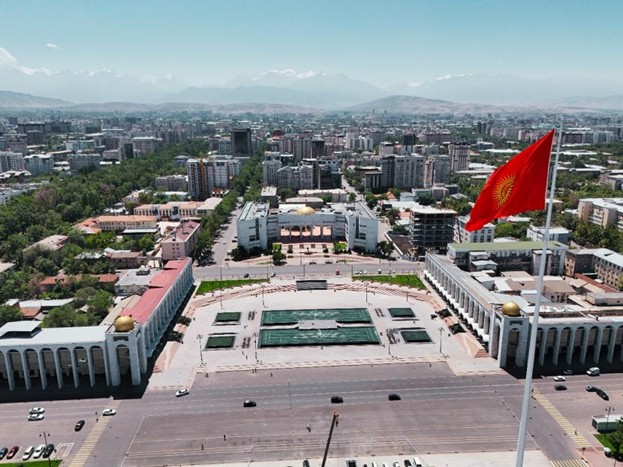
Photo: Bishkek, Chui Avenue.
This may sound futuristic, but it becomes realistic when public authorities work in partnership with advanced technology companies. For example, INTEGRA CITY, as one of the international leaders in the digitalization of the urban environment, offers an integrated approach: it brings transport, utility and administrative infrastructure together into a single smart ecosystem. The Integra digital platform collects data from multiple sources, turns it into valuable insights and directs it to where it can truly create value. This approach enables the integration of fragmented technologies into one coordinated network — from traffic and urban environment management to monitoring territorial infrastructure.
Digital urbanization — a solution for citizens
Creating a digital ecosystem for a metropolis makes it possible to manage urban processes and resources effectively in real time. For example, integration with transport systems helps manage traffic and reduce congestion, minimize road accidents, while safety and video surveillance systems ensure a rapid response to incidents and violations. Data on the condition of engineering networks, in turn, makes it possible to monitor and improve quality of life, efficiently manage street lighting, networks and water resources.
Citizens can control these processes through an application without leaving home. This reduces the distance between the population and the authorities, while also making solutions more accessible for people with limited mobility.

Photo: Pavel Loran, Head of the INTEGRA CITY Group of Companies’ Representative Office in Central Asia.
“We create feedback interfaces: mobile applications, online services and civic participation modules. This helps build an environment where the city hears every resident,” emphasizes Pavel Loran, Head of the Representative Office of INTEGRA CITY – FZCO Group of Companies in Central Asia. “Our mission is to create Safe and Smart Cities that become part of a unified digital platform for the country. We plan with a 10–15 year horizon, which allows us to consider future needs and ensure sustainable development. We use both our own experience and global trends to create solutions that simplify citizens’ lives and make them safer and more comfortable.”
Today, Bishkek is at a stage of significant transformation, where technology is viewed not only as innovation, but also as an effective tool for ensuring a fair and safe urban environment.
The metropolis has the potential to become one of those cities where digital infrastructure effectively serves the interests of everyone. To achieve this, it is important to entrust management to centralized systems capable of integrating all urban processes and providing comprehensive solutions to city challenges.