
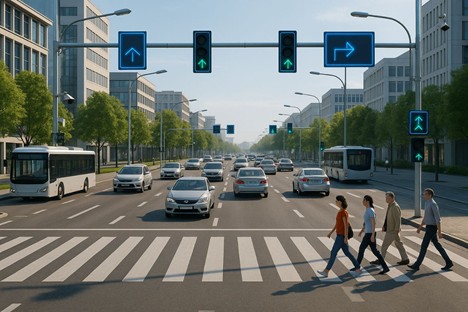
The image was created using AI and is for illustrative purposes only.
Which solutions help collect data from sensors and devices and forecast possible infrastructure issues?
Kazakhstan is taking confident steps in developing smart cities, where technology is becoming not merely an automation tool, but a condition for comfortable and safe living.
According to the 2024 results of the ranking by Kazakhstan’s Ministry of Digital Development, Innovation and Aerospace Industry, Astana, Almaty and Karaganda became the leaders. Interestingly, five years ago Almaty held the top position, but today the top three demonstrate the steady development of digital infrastructure across the country.
The priorities of smart cities in Kazakhstan have remained consistent since 2019, when the reference standard was approved. Safety, transport, housing and utilities, education, healthcare and city management are the key areas where high-tech solutions are being implemented. Local authorities actively use school performance monitoring systems, electronic fare payment, online clinic appointments and citizen request platforms such as the 109 contact center.
However, a modern smart city is not simply a collection of sensors and cameras. It is an ecosystem in which residents become active participants in change. Next-generation digital platforms make it possible not only to collect technical data, but also to take into account citizens’ opinions, complaints and proposals. This forms a new model of interaction, where everyone can influence the development of the urban environment.
Anticipation instead of reaction
Modern technologies allow the city to be seen as a living organism. Systems analyze data on lighting, waste accumulation, public transport operations and even identify high-risk intersections. This makes it possible not only to eliminate problems, but to prevent them. For example, residents of the Almaty Region will be able to report illegal dumps or broken streetlights through a mobile application, while the system will automatically direct requests to the relevant services.
Today, a city is no longer merely a set of buildings and streets. It becomes a complex, interconnected ecosystem that lives and responds to residents’ needs in real time. Digital technologies not only record failures, but turn data into practical decisions, involving every resident in the creation of a comfortable and safe environment.
“If it becomes possible to report problems quickly and see the result, I would like the city of Konaev to become truly smart. Everything becomes simpler and clearer, which means more efficient,” says Maksat, a resident of Konaev, the administrative center of the Almaty Region.
Zhetysu Region: digital transformation according to plan
In the Zhetysu Region, digital transformation is developing within the framework of the Digital Kazakhstan state program, aimed at creating a modern, comfortable and high-tech region. Today, the region is laying a solid foundation for a modern digital urban environment that improves quality of life and supports economic development.
Projects being implemented include automation of public services in education, launch of the unified 109 contact center, and creation of a regional IT hub that is becoming a center of attraction for innovative technologies and young specialists. These are only part of the changes taking place: digital tools are being actively introduced in other areas as well, from healthcare to urban infrastructure.
In the coming years, active development is expected in intelligent transport systems, smart utility networks, smart lighting systems and data centers. These technologies will significantly improve the efficiency of municipal management, making transport more convenient and public services more transparent and accessible for residents.
It is reasonable to unite all digital solutions into one manageable platform that becomes a centralized mechanism for controlling and coordinating the work of different infrastructure facilities. Such integration will ensure prompt decision-making and rapid response to any changes, making regional management flexible and adaptive.
Special attention is being paid to energy-saving and environmentally friendly technologies. Smart lighting systems, in particular, reduce energy consumption and support the region’s sustainable development by improving the environmental situation and creating a comfortable living environment.

The image was created using AI and is for illustrative purposes only.
“It is important that the transport system truly meets the needs of citizens: routes should be well planned and trips should take as little time as possible. It is encouraging to see new digital solutions emerging. We want them to make getting around the city faster and more convenient, especially in the morning, when people need to take children somewhere or get to work,” says Ainur, a resident of Taldykorgan, the regional center of the Zhetysu Region.
She also notes that residents expect improvements in other areas of urban life as well: smart lighting will make streets safer at night, and modern digital solutions in housing and utilities, such as waste removal monitoring with resident notifications, will help improve cleanliness and order in courtyards. These are steps toward a convenient and modern urban environment where continuous dialogue with residents and consideration of real needs play an important role.
A digital ecosystem for the cities of the future
Kazakhstan is moving from fragmented digital services to comprehensive intelligent platforms, attracting well-deserved attention from countries both near and far abroad. Such integration makes it possible to unite key areas of urban life, including utilities, transport, safety and communication with residents, into a single system for more efficient management.
The market offers various technological solutions from international and local companies such as NEC, SAP, Huawei and others, which automate separate processes and services. Yet creating a single ecosystem where all city services work coherently and data is combined on one platform remains rare.
Residents receive convenient tools to interact with city services and greater opportunity to influence the development of the urban environment. The introduction of such integrated digital platforms is gradually shaping new standards in city management and urban-tech.
Pavel Loran, Head of INTEGRA CITY’s Representative Office in Central Asia, spoke about the future development of digital ecosystems and the implementation of such solutions in Kazakhstan.

Photo: Pavel Loran, Head of the INTEGRA CITY Group of Companies’ Representative Office in Central Asia.
“Advanced technologies are becoming a natural part of the urban environment: invisible in operation, but highly visible in their results. When systems work coherently and data is transformed into clear decisions, this creates a qualitatively new level of city service. This is exactly the benefit—measurable, specific and meaningful for every resident—that we make a priority in our solutions.”
The platform is being implemented in several cities of Kazakhstan. It brings together fragmented systems—lighting, transport, utilities and safety—into a single digital network. Connected sensors and devices collect real-time data about the environment and infrastructure. Within the platform, large volumes of data are then processed to forecast problems and support appropriate management decisions.
The speaker noted that implementing such integrated platforms in Kazakhstan could substantially improve city management and residents’ quality of life, ensuring faster and more transparent interaction between services and the population.
The Integra platform can unite municipal, transport and emergency services into a single operating system. It creates synergy between infrastructure, data and people, where each element strengthens the effectiveness of the others. As a result, cities receive not only optimized processes, but also a new level of quality of life for residents.
A smart city is not only about technology; it is also a platform for dialogue between authorities and residents. Data and citizen feedback brought together in one system make it possible to take informed decisions, making Kazakhstan’s cities more convenient, safer and more comfortable for life.