
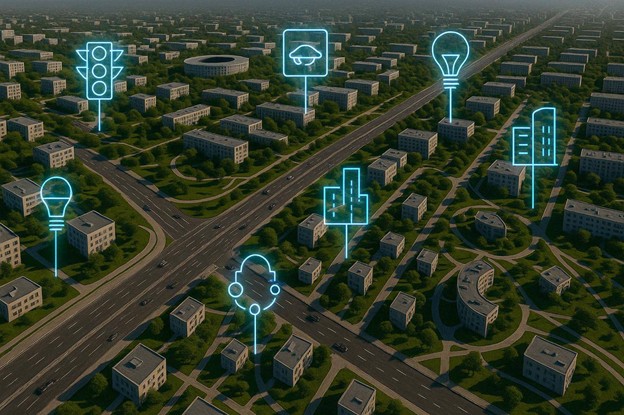
The image was created using AI and is for illustrative purposes only.
Imagine a city where you leave home in the morning and there are no traffic jams. Traffic lights have already calculated the load and redistributed the flow of cars in time. A street cleaner appears not “by order from above,” but when sensors show that it is time. A mother lets her child go to school with peace of mind, knowing that smart cameras along the route do not merely observe, but can immediately report suspicious situations to emergency services.
This is what a smart city means: not science fiction, but a reality already operating around the world.
For example, in the Chinese city of Shenzhen, more than 70% of public transport consists of electric buses, and autonomous technologies are actively developing. Sensors across the city monitor air quality, water leaks and traffic congestion. As a result, crime has decreased by one third and water losses by 20%.
In Barcelona, waste bins signal when they need to be emptied, while smart lighting turns on only where people are present. This helped the city save EUR 75 million in just a few years.
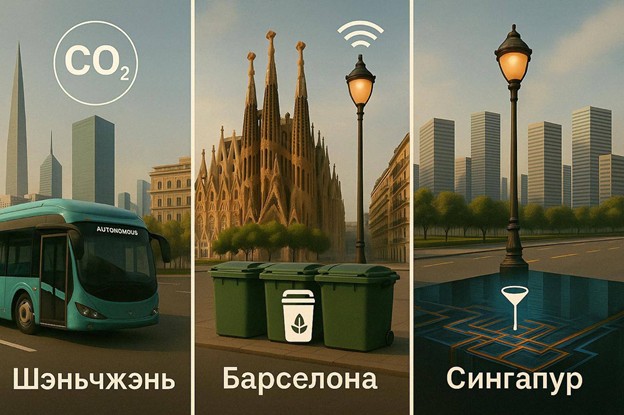
The image was created using AI and is for illustrative purposes only.
Singapore has a full digital twin of the city: a virtual copy where everything is visible, from underground pipelines to trees in courtyards. This helps identify and solve problems before residents even notice them.
What about Kazakhstan?
According to the Bureau of National Statistics, as of March 1, 2025, Kazakhstan had a population of 20.3 million. Most residents already live in cities: 12.8 million in urban areas and 7.5 million in rural areas. Since the beginning of the year, the trend has been clear: the rural population decreased by almost 8,000 people, while the number of city residents grew by more than 40,000 in only two months.
Thus, the share of the urban population is approximately 63%. This is only the beginning. According to UN forecasts, by 2050 this figure may rise to 70%. In other words, every second or even every third citizen of Kazakhstan will be an urban resident.
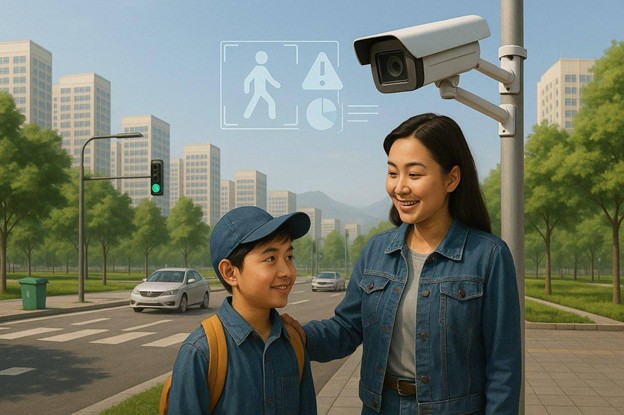
The image was created using AI and is for illustrative purposes only.
This means the question is no longer whether Kazakhstan needs smart cities. The real question is whether we can build them before legacy systems fail under growing pressure.
According to a McKinsey Global Institute report, the introduction of smart city technologies can reduce commute times by up to 20%, improve the efficiency of municipal services by 30%, reduce crime by 40%, and save up to USD 100 billion annually worldwide.
If we are speaking about the future of cities, we need to start building it now, especially in regions where there is still space for smart solutions. The Almaty and Zhetysu regions are good examples: population is growing steadily, new residential districts are being built, and small towns are developing. Along with this growth, pressure is increasing on roads, engineering networks, utilities and emergency services.
Residents of these regions are already familiar with the problems that smart cities can solve: illegal dumping, water supply interruptions, poor street lighting at night and slow emergency response. These are all consequences of inefficient resource allocation, lack of data and manual management.
Why is this important now?
This urban growth also creates a window of opportunity. While infrastructure is still being formed, it is the right time to embed modern digital solutions into it. These may include automated traffic management systems that flexibly regulate traffic and reduce accidents, digital twins of engineering networks that monitor communications in real time and prevent breakdowns, and sensors for water supply, lighting and air quality. Such solutions are already possible through platforms offered by Integra City, Presight AI, ST Engineering, Paradox Engineering and other companies.
Today, companies are creating universal digital platforms that unite transport, utility and administrative infrastructure into a single smart ecosystem. One of the flagships of this transformation is Integra City.
The company has developed an innovative next-generation platform called Integra. The system effectively restarts urban infrastructure: it collects data from multiple sources, turns it into valuable insights and directs it where it can deliver real impact. This approach makes it possible to integrate fragmented technologies into one coordinated network, from traffic and urban environment management to territorial infrastructure control.
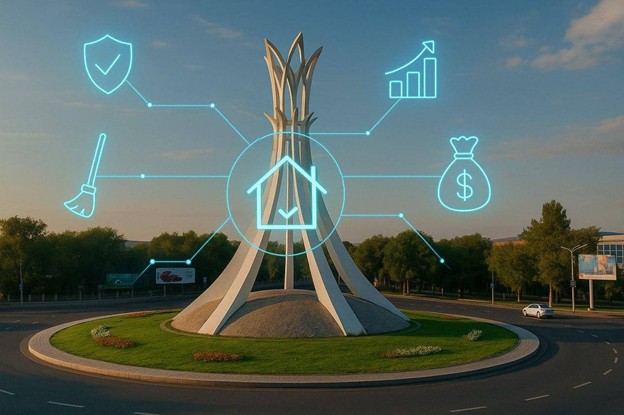
The image was created using AI and is for illustrative purposes only.
Integra adapts flexibly to different conditions. It can be integrated into existing infrastructure or built from the ground up for the specific needs of a city. The effect can be felt quickly: fewer road accidents, lower crime rates and less pressure on urban systems. Smart sensors for water, lighting and air quality are no longer a concept, but a working reality delivered by Integra City. The platform does not simply connect isolated elements; it transforms the urban landscape, making it smart, safe and genuinely comfortable for life.
Alongside Integra City, other technology players are also actively developing smart city solutions. Presight AI builds advanced analytics for forecasting and real-time decision-making, ST Engineering implements intelligent transport and security systems, and Paradox Engineering specializes in integrated urban infrastructure, from lighting management to IoT integration. Together, these companies are shaping a future in which cities become not only technological, but truly living and adaptive.
Continuing to develop in the old way means catching up. Introducing technology from the very beginning is a chance to move ahead. Smart cities are not built in one day, but the sooner the journey begins, the sooner residents will feel the results.