

The image was created using AI and is for illustrative purposes only.
Today, countries compete not only for investment, talent, and technology. Computing power is increasingly becoming a strategic resource that underpins artificial intelligence, digital services, and modern governance models.
Every AI-powered service—from digital assistants to computer vision systems—requires enormous computing resources. As a result, a new global infrastructure race is underway. Governments are investing billions of dollars in data centers, while leading technology companies are searching for locations capable of providing the energy, connectivity, and computational capacity required for the future AI economy.
Kazakhstan aims to secure its own place in this race. According to OpenAI, the country ranks among nations with a high level of AI adoption and is among the world’s top users of ChatGPT. Kazakhstan’s digital maturity was further confirmed by the Oxford Insights Government AI Readiness Index 2025, where the country ranked 60th out of 195 nations—the highest result in Central Asia.
Additional momentum is being provided by the national Digital Qazaqstan Strategy through 2029, which prioritizes digital infrastructure, artificial intelligence, and the data economy. Against this backdrop, the Data Center Valley project in Ekibastuz, investments in national AI infrastructure, and the broader vision of building a next-generation state are creating a new growth engine for Kazakhstan’s economy and technology sector.
Why Data Centers Are Becoming a New Industry
The Data Center Valley project, based on the Ekibastuz energy hub, is expected to become one of the largest infrastructure initiatives in the region. Total investments are projected at approximately USD 30 billion. The first data center is expected to be commissioned in 2027 alongside the required engineering infrastructure.
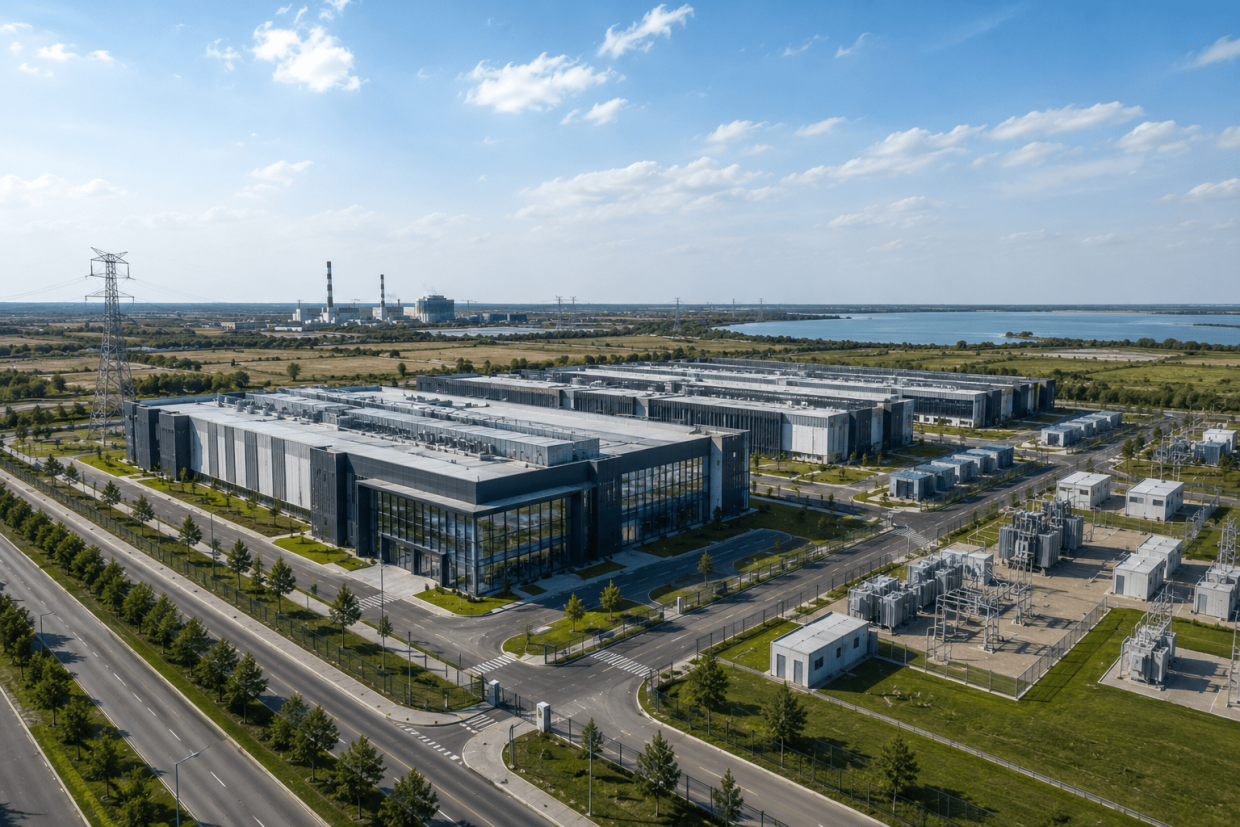
The image was created using AI and is for illustrative purposes only.
The significance of the project extends far beyond additional server capacity. Today, modern computing infrastructure is becoming as important to investment attractiveness as industrial zones, transport corridors, or access to energy resources once were. AI companies increasingly choose locations where they can rapidly scale digital products and access reliable computing resources.
As a result, large-scale data centers are becoming catalysts for entire technology ecosystems, bringing together startups, AI developers, cloud service providers, research institutions, and international technology companies.
For Kazakhstan, this represents an opportunity not only to attract investment and create jobs but also to strengthen its position as one of Eurasia’s emerging digital hubs. The expansion of computing infrastructure also provides the foundation for wider AI adoption, more advanced digital services, and increased economic competitiveness.
From Servers to Smart City Services
International experience shows that data center development rarely ends with infrastructure construction alone. It is typically followed by the emergence of companies delivering solutions in artificial intelligence, digital government, urban analytics, and public safety.

Photo: INTEGRA CITY .
One such company is INTEGRA CITY, an international technology group developing platforms for smart cities, situation centers, video analytics, and digital government services.
Although data centers remain largely invisible to citizens, they serve as the foundation for technologies used every day. Smart city management systems, video analytics, digital government platforms, transportation services, and public safety solutions all depend on the ability to process vast amounts of data in real time.
According to INTEGRA CITY representatives, access to computing resources is becoming one of the key factors determining the speed of AI implementation.
“Artificial intelligence is no longer a standalone technology. It is becoming an integral part of city management and public services. Video analytics, digital government services, situation centers, and urban infrastructure monitoring systems all rely on data and require significant computing resources.
In this context, the Data Center Valley project is not merely an infrastructure initiative but an important element of the future digital economy. Projects of this scale create the conditions necessary for integrating AI into public administration, developing smart cities, and launching new digital services for citizens and businesses.”

Photo: INTEGRA CITY .
Security as the Foundation of the Digital Economy
As governments increasingly deploy AI and digital services, requirements for data protection, infrastructure resilience, and digital sovereignty continue to grow. The development of computing capacity must be accompanied by equivalent investments in cybersecurity.
As data centers expand and the volume of processed information increases, protecting digital infrastructure becomes just as important as developing the technologies themselves. Reliability, resilience, and security directly affect the effectiveness of public services, user trust, and a country’s ability to adopt new technological solutions.
Olzhas Satiev, President of TSARKA Group, one of Central Asia’s leading cybersecurity companies, believes security has become an inseparable component of digital economic development.
“The development of data centers is not only a matter of computing power but also of national cyber resilience. The more critical data and digital services are hosted domestically, the greater the requirements for protection against cyberattacks, data breaches, and external interference.
Technological sovereignty enables governments and businesses to maintain control over data, infrastructure, and digital processes while reducing dependence on foreign platforms and geopolitical risks. Cybersecurity should therefore be embedded into data center architecture from the very beginning rather than treated as an additional feature.”
Kazakhstan on the New Global Technology Map
The development of national AI infrastructure, the launch of Data Center Valley, the growth of Alatau, and cooperation with global technology companies demonstrate that Kazakhstan is investing not only in digitalization but also in building its own technological foundation.
For businesses, this means new opportunities for growth and investment. For startups, it provides access to world-class computing resources. For the government, it creates the foundation for data-driven and AI-powered governance. For technology companies, it offers an opportunity to develop and scale next-generation solutions in digital government, smart cities, and public safety.
This is why data centers are no longer simply elements of digital infrastructure—they are strategic assets that will determine a country’s position in the global AI economy.